Saturday, December 18, 2010

Ski until you're wrecked!

Bretton Woods partially recovered from last Sunday's warm deluge. They re-opened 30km of trails. Conditions were vastly different though. The base was very thin, hard, with a little packed power on top. It did not mask any of the natural contours of the earth underneath. This meant a full suspension mountain bike would have been a much more suitable means of conveyance. By staying super cautious, I managed to stay upright for the duration, but Dave and Brett had a few "blemishes" in their workout.

There was a good loop nearly 10km in length that went over Coronary Hill via the Sebosis trail. The vertical pales in comparison to Waterville's 800ft Tripoli Rd climb at only 350ft. Challenging conditions made up for it. There were open waterbars, deeply rutted icy sections, occasional roots, dirt poking through and more.

My goal was to ski N+1 laps, where N was the number of laps to cook me. Then do one more. N was 3 today, so we did a 4th lap. About seven months worth of accumulated injuries all caught up to me on the fourth lap. Titanium ankle went into major funk, my good ankle which I tweaked a month ago went achy on me, and my sprained wrist from back-flipping on ice last weekend refused to transfer force to the pole. I felt like a 48 year old man. Aren't we athletic types supposed to feel younger than our age?

Anyway, we decided to do our last lap in reverse skiing up B&M trail. Brett was bonking with Dave and I trailing. Dave got impatient, asked to pass. Of course I wasn't going to let Dave ski away from us. I had to get by Brett too, against all common sense. I'm sure I looked like I was skiing with a broken leg and arm chasing Dave up Porcupine. Dave threw down the gauntlet on the descent. I put out the white flag. I was wrecked enough without taking a header through the sketchy sections. We skied very nearly 40km in 2.6hrs. A good second time on snow this season.  I forgot to bring my camera, so you're stuck with a boring profile plot.


Besides killer views of Mt Washington, one of the best parts of skiing at Bretton Woods is a warm shower and fresh towels afterwards. It's included with the trail pass. Interestingly, while we were kitting up before the ski, a bunch of high school team girls stormed the men's room to use our toilets. Guess they were on the road a while and the line was too long in the girls bathroom. I hope they at least sent a boy in to scout it out first, as the showers are directly across from the toilets.

Looks like my next chance to ski will be in Michigan at least a week from now. Thanks for reading.

Friday, December 17, 2010

What's all this running stuff about anyhow?

A few weeks ago, I caught up with an old Raytheon colleague at the Brewery Exchange in Lowell.  In addition to work war stories, we talked about my injury this spring. I mentioned how I missed an Italian cycling trip and the Leadville 100 MTB race, and how I might need to start running. Paul had recently read the book "Born to Run" by Christopher McDougall. I used to read books more frequently. These days, why would I read when I could be riding or skiing? Anyway, Paul mentioned the book is about all these crazy endurance athletes, including the rise of the Leadville Trail 100 foot race. That got my attention. This was before I had my bone density scan.

Paul sent me his copy to read. I've nearly finished it. It covers an interesting cast of characters in the realm of ultra endurance running. McDougall delivers a message. Just like the paleo diet folks claim modern diet is killing us, McDougall claims modern running shoes are the source of many running related injuries. When our feet get all cushy and supported in these modern marvels, our feet get lazy and we run completely wrong, striking on the heel. The stars of McDougall's book are the Tarahumara, an isolated indigenous population hidden deep in Copper Canyon, Mexico. These people can run a hundred miles any day with minimalist shoes. They do not get injuries. How is that? McDougall strives to find out. The answer is the Tarahumara practically run bare foot. This makes your feet strong and instinctively forces you to land correctly on your feet, the way our feet have evolved to function. There's a great 10 minute clip on the Tarahumara here.

Today I began to work on my low bone mineral density. I ran. My last foray into running a few years ago was disastrous. This time I'm going about it methodically. I followed Dan Moriarty, an elite tri-guy from work, to the Merrimack YMCA. Dan offered to critique my running on a treadmill. The short of it is I didn't look too bad. I need to relax my upper body more and keep my back more vertical, but I seemed to be striking both feet the same and with decent form. I ran a total of 2 miles on a 1% incline. When I got back to work minutes later, I couldn't believe how wrecked my legs felt. What hurt the most was the side of my leg at the top of the titanium plate. Hope I don't have a stress riser there that will give me grief. In the Excel training log I keep, my activity drop-down has "run" in it. I finally used it again. Here's what my activity mix for the year looks like now:

Run is not zero anymore. A few years ago pie chart was almost
all road cycling.

So now I have to look into running shoes. Should I be influenced by McDougall's book? Dan kind of scoffs at McDougall's anti-corporate rant. I don't plan on running hundred milers some day. I don't plan on running as training for running. I need to bring balance back to my body. I'll have to see the folks at Runner's Alley in Nashua. A super plush shoe probably isn't in my interest. I want to start out with good form and avoid the immediate injury I encountered the last time I tried to run.

Monday, December 13, 2010

Cycling is bad for your health

I scored a double feature at the doctor's office today. My wrist was so sore this morning I could not brush my teeth, dress myself or turn doorknobs. I'm a righty and I landed hard on my right arm when I back flipped on black ice yesterday. So for about the third time in a month (leg, bone scan, and now wrist), I was on an X-ray table again. I joked with SteveG at work that I need a punch card, so I get every fifth X-ray free. Salem Radiology certainly knows me now.

I have to wait for the radiologists to look at my wrist images, but the tech let me peek, and to our eyes, there were no obvious fractures. A fractured scaphoid would have been a disaster, as those require 12 weeks cast time and usually a screw. My son is mid-way through a scaphoid fracture recovery. No fun at all.

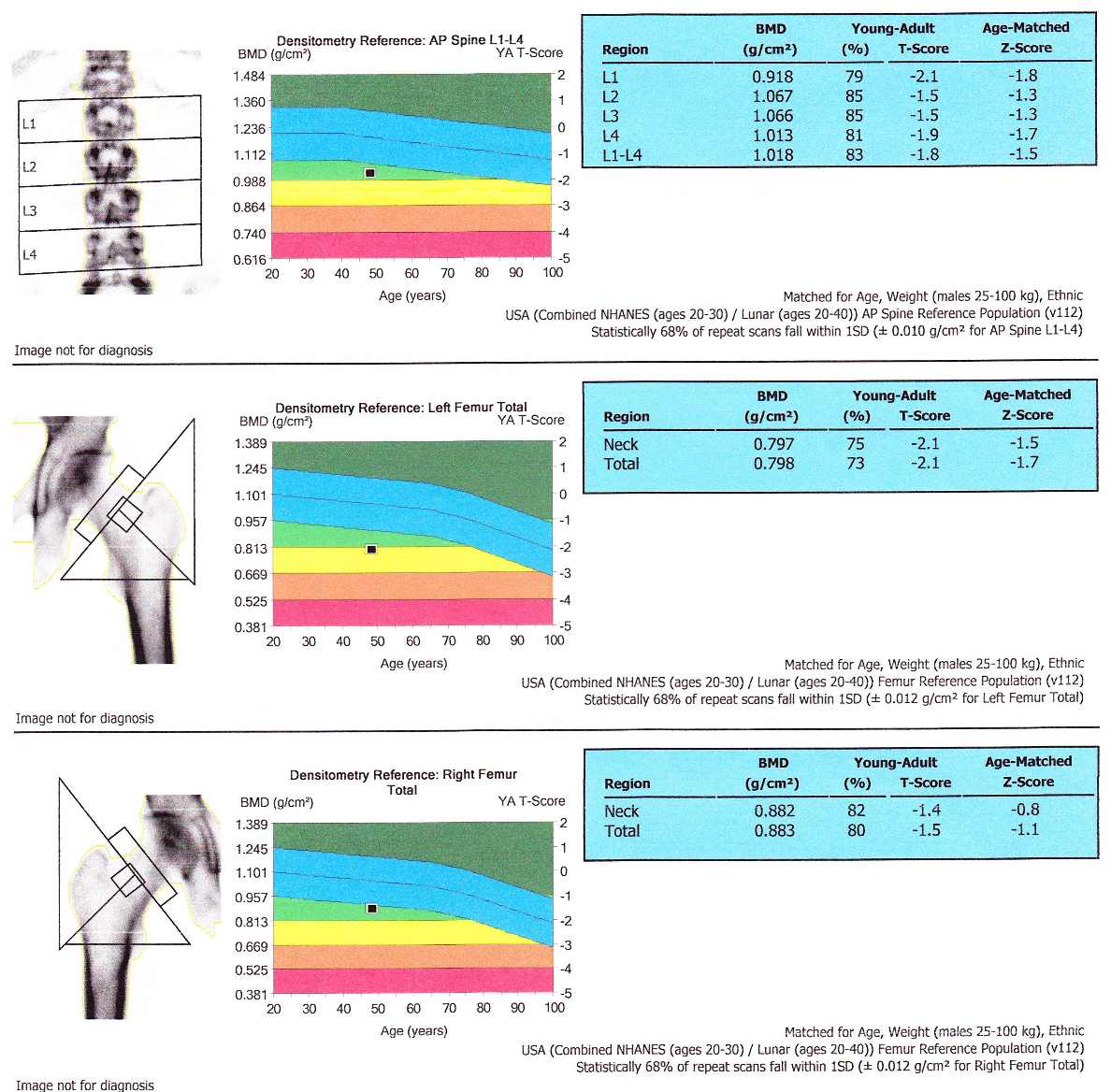
So what was the double feature? The bone density results were in. I kind of already knew what to expect, as the X-ray tech shared what the machine was indicating last week. My bone density is low. The first chart below shows my measured results. Ideally, I should be in the middle of the blue zone for 48 years old. The blue band is the normal range. Note it kinks downward with age, as after a certain age, we all loose bone density.


The next chart draws conclusions from the measurement. My spine and right hip are moderately low density, and this places me at moderate fracture risk. My left hip has low bone mineral density, and this places me at high fracture risk. In fact, my left hip is getting pretty close to the osteoporosis threshold. My condition is medically called osteopenia, which is basically pre-osteoporosis. Some people, mainly those from alternative medicine disciplines call osteopenia a disease that was invented to sell drugs. Others claim it is nothing more than low side of normal. But still, there's no getting around that my BMD is about 20% below average for my age.


My doctor said I was a most interesting individual. I had a pretty big difference between my left and right hips. He pondered why this would be. I had a ready answer. I spent a big chunk of the summer zero weight bearing on my left leg. Thus that hip atrophied while my right hip held its ground.

The doctor said there were two ways to go about dealing with this - drugs or physical activity. I have no interest in taking BMD enhancement drugs. Some very scary things have surfaced with those recently, some horrific side effects. I have to work more weight bearing activity into my weekly routine. He did not recommend running, although from what I read, it is one of the surest ways to stave off bone loss. Not sure what my plan will be yet. It is ironic that I went out for a hike Sunday for the purpose of getting more weight bearing activity, and that very thing sent me to the doctor the next day. Just can't win. The doctor recommends simply walking. Wonder how much I have to do to make a difference? I have a year before a follow up scan to check progress.

So could low BMD in my hips and spine have been linked my ankle fracture in May? Maybe weakly. I bet having little lateral stability in my ankles had more to do with it, since I do so little weight bearing work. In 2008, a study was published by the University of Missouri comparing BMD of cyclists and runners. The cyclists were 7x more likely to have osteopenia than the runners! This included subjects in their 20's. There's a saying out there in the elite ranks that you should rest when not riding, sit if you don't have to stand, and lie down if you don't have to sit. This rules out any kind of impact or weight bearing on the skeleton. I do ski in the fall and winter, but this is very low impact. Studies have shown that high intensity resistance training can also maintain bone density. There's a nice summary of Bone Health in Cyclists here.  I not only need to curb the loss, I really need get my BMD back into the normal range. The risk of my activities is compounded by low BMD. Crashing in a road race entails increased risk. Mishaps happen all the time riding off-road. Even XC skiing sees its share of fractures in races.

There are other factors too, the doctor didn't discuss. There's some evidence out there that high intake of processed carbs and animal protein can result in bone mineral loss. I eat lots of both.  Additionally, high coffee consumption has been shown to interfere with calcium absorption. I've always been a big dairy products eater, so I doubt I was ever deficient in calcium in my life. I do think I could have been vitamin D deficient in winter months though. The doctor advised me to take a D supplement, which I have been since my fracture. Calcium cannot be absorbed unless vitamin D levels are adequate. So do I have the will power to shun Starbucks? I drink three cups per day, essentially grande sized, and very strong. This might be equivalent to six regular cups of fast food chain or Dunkin Donuts coffee per day.

So one can focus on cycling, podium masters road races, even win a hillclimb championship series, but still be in pretty pathetic shape overall. It is cruel that what can be so kind to your joints and help you achieve incredible cardiovascular fitness, can also leave you woefully out of shape in many other ways. I've started addressing some of the core deficiencies, now it's time to take the next step (literally) to address BMD deficiencies.

Sunday, December 12, 2010

My Feud with Ice Continues

Friday's successful ski was followed up by a less than perfect trail ride on Saturday. SteveG and I headed down to the Great Brook area for a 30-40 miler. Yeah, I know, I refuse to learn. Riding with Steve has put me on the X-ray table twice so far this year. Saturday's ride taunted fate, as Steve claimed fresh legs and I claimed wrecked status from skiing the day before.

To get 40 miles in at Great Brook, one needs to link in every bit of conservation land in Chelmsford. I figured we could start out with the more roadie-ish stuff first, let Steve hammer some of the freshness out of his legs, and then maybe I wouldn't break a leg trying to stay with him on Stone Rowe later in the ride.

We didn't get too far. In Lime Quarry Reservation, Steve flatted. I was a bit horrified by the condition of his tire. There were no less than four places the tube was bulging out the sidewalls. No worries. He brought lots of milk jug tire boots just in case. A new tube and some boots got things rolling again. We zipped through Wright Reservation next, then on to the powerlines. He flatted again over some rocks. This time glueless patches were used on the double pinch flat.

Remounting the wheel, the brake rotor missed going in between the pads and buggered up the pad spacing spring. Turns out this is really easy to do when the pads are worn down to metal so the calipers are all the way out. While fussing with the caliper, the tire started hissing! It seems glueless patches don't hold well when it is cold out. I think we killed better part of an hour before we got rolling again.

Just in Great Brook, the tire went squishy again. That tire was a hopeless cause. Steve hung it up and rode two miles back to the car on a flat tire. Perhaps I obsess over bike maintenance more than some, but riding on a tire with multiple sidewall tears?  I was determined to get three hours of riding in and kept going. I hit Russell Mill next, where 100% of the trails were swept clean of leaves. The ground was frozen hard as pavement. It was marvelous fun, maintaining a solid tempo pace the whole time. There must have been twenty other riders in there. I rode most of the Great Brook trails, finishing with 36 miles in 3.3 hours moving time. No mishaps!

Sunday was a mess. I entertained skiing again, but the rain was already upon us. The roads were salted too, to knock down black ice. So what would suck the least? Cathy was game for a hike. My New England readers know what kind of weather we had Sunday - very high winds and heavy rain. It never let up. It was relatively mild at the house with the temp in the 40's, but it was sure to be colder higher up. Would there be ice? We still don't have crampons.

We drove out to Pack Mondanock. Seeing thick ice on the shoulders of Rt 101 near Wilton pissed me off, as that is how our doomed Cardigan hike started a few weeks ago. But strangely, as we drove up to Miller State Park, the ice disappeared. There was no ice in the parking lot. I was surprised to see one car there. I did not expect to see any.

The wind nearly ripped our Goretex layers away as we put them on. I bet it was raining at one inch per hour. Neither of us had waterproof shoes. We decided to hike up the Marrion Davis Trail to the summit. There was lots of standing water in the trail, but zero mud. The ground was frozen solid but not slippery. I was looking to get some impact by hiking at an aggressive pace. After summiting, I would hike back down and join Cathy for the rest of her climb. We'd then take the paved road back down together.

Cathy nearing the summit

I got in a solid aerobic workout, climbing nearly 1000ft in about 25 minutes. Needless to say, it was raw at the summit and not a place to hang out. After a photo, we started a brisk pace down, I was lightly jogging some of the less steep parts. I wasn't paying attention and hit a patch of ice. It was visible. I still had my trekking poles out and they helped me stay upright.

Rain going sideways at the summit

About halfway down, Cathy and I were jogging along again, when suddenly I experience the sensation of an explosion between the ears. Cathy and I both went down on black ice. I hit the back of my head so hard on the pavement that it bounced my body back up into a seated position. I did not black out. I accelerated on the ice until the crown of the road slid me into the weeds. I bet I went 100ft. It took a while before I could get up. The first thing you think is concussion or bleeding in the brain. A couple of things might have saved me. The impact was more towards the top of my head than base of my skull. I must have crunched my abs, so that my head tipped all the way back before hitting the pavement. Those situps I've been doing are paying off. I also had a pretty dense fleece hat on that no doubt softened the blow. Fortunately, Cathy did not hit her head.

We had no choice after that but to walk in the rough along the road, as in the rain, the black ice was completely undetectable on the asphalt. Impact to the head was not what I had in mind for the descent. Now we were soft-walking it the rest of the way down. Later my right wrist swelled up pretty badly. Sure hope I didn't mess something up in there. I had an ostrich egg sized lump on my head.

Winter needs to decisively settle in. Then it is either skis or studded tires on snow, none of this CX bike or hiking on ice stuff. I'll be lucky if I make it to 2011 intact.

Friday, December 10, 2010

First Snow


Dave, Brett and I kicked off the XC ski season with an awesome session in the mountains today. Parts of northern Vermont and New Hampshire received sizable dumps over the last week. Waterville Valley, where we hold season passes, has not opened any trails. Bretton Woods, which uses Mt Washington as a snow scoop,opened about half of their terrain.  We were in for an abrupt transition from fall to winter. Before leaving the house, Weather.com gave these conditions for Bretton Woods:


It wasn't the temperature I was so much fretting over. It was sandpaper snow I feared. Normally fresh snow in extreme cold has glide characteristics similar to beech sand. We were pleasantly surprised to find quite good glide.

We climbed to the high point (about 400ft net gain) of the trail system three times. First loop out we went out to Crawford Notch. All of the trails in the woods were snowmobile groomed. Only a portion of the golf course was groomed by the Piston Bully. Snowmobile grooming means a lot of varying off-camber and whoopy skiing. It was also very soft in places. Still better than skiing early last season here with 2ft of new snow. Then skis kept punching through. I hit the Crawford climb quite hard, about seven minutes of solid VOmax effort.

Climbs two and three were laps around Sebosis/Porcupine/B&M. First time up Sebosis, I burned half my matchbook, holding near VOmax effort for 15 minutes. That cut me down a notch. You always feel like a superstar skiing down B&M, an old railroad grade at 1-2%. We looped around the golf course, climbed Wiley's, which had Dave and Brett bitchin' (it was wicked soft), then finished by going up Porcupine and down Sebosis.

Brett coming down Porcupine Lane

Dave and Brett had enough by this point and went in, but I still had some mojo left and went for a lap and a half around the golf course.  I brought my Atomic RS:11's, freshly ground by Boulder Nordic Sports. I got a general purpose grind good for cold temperatures. These were my rock skis before grinding. They weren't exactly in mint condition after grinding, but the bottoms looked pretty nice. I don't have another pair of rock skis. I worried about snow coverage initially. Ironically, I never hit anything in the woods where sticks and weeds where poking through. It was on the golf course that a rock put this pair of skis right back into rock ski status.


I finished with 33.6km distance and 520m climbing in 2:32hrs on the Garmin. This more than doubled any rollerski workout I've done this fall. My left ankle was none to happy about it. It seems rollerskis on pavement go in the direction you plant them and nothing perturbs that trajectory. Skate skis in soft, irregular conditions have all kinds of additional forces acting on them. Take some of the climbs for example. They were groomed too narrow in places to effectively skate, so tips tended to catch. This creates huge torsional load on ankles, something rollerskis don't do. My right ankle seemed did fine. I suspect my left ankle still has some toughening up to do since the fracture this spring.

Regardless of ornery ankles, I got a superb workout in. I haven't pushed myself that hard in many weeks. After a solid workout in the woods with friends, the psyche is prep'd to handle anything the world throws at it.  Hope the mountains keep snow through a brief warmup this weekend. Going back to rollerskis during the week is going to suck.

Wednesday, December 8, 2010

Newton's Hill

On several Sunday's now, I've met Brett for rollerski drills in the Westborough Business Park by his house. Maps call the hill this park sits on "Newton's Hill". There is a wide road, when coupled with a parking lot driveway, that nearly reaches the high point of the hill. In all, it gains about 160ft at a very consistent 6% grade. This is perfect for climbing intervals.

Newton's Hill

What is so cool about rollerskiing here is we pretty much have the place to ourselves on a Sunday morning. Maybe three cars will go by in an hour's time. No neighbors giving you stink eye and plenty of room for cars to go by.

Steady Grade

Ten repeats pretty much cooks me. I can V2 it in less than four minutes, but typical intervals run 4-4.5 minutes. Great for VOmax work. This past weekend we tried free skating up it. A month ago I don't think I would have survived this. I've been focusing a lot lately on free skating without poles. I learned I really haven't been tapping into my leg strength much. When free skating up a hill, either you get over each ski with a good snap or you don't go anywhere. Since I've started free skate laps on my lunch loop, I've dropped my free skating time about 15-20%.

The weekends continue to be quite conducive for long rides. On Saturday, Dave and I opted to for fat tires on trails rather than risk another debacle like the prior weekend with CX bikes on ice. There are trail riding options in southern New Hampshire where one can ride five hours and barely see pavement. One such route links up Massabesic Lake, FOMBA trails, Tower Hill Pond, and Bear Brook State Park via Trail 15. You do ride a portion of Trail 15 both directions, but large loops can be ridden at either end. Dave and I did a 48 miler in 4.8 hours, hitting limited bits of FOMBA with a nice loop in Bear Brook. You actually cover a lot of territory in this ride and feel like you accomplish something.  We saw a few other riders out there and a lot of guys with guns. Why is it when you ride away from guys with weapons, you feel like they are lining up a bead on your back? I get the same feeling when I am riding in bear or mountain lion country. Anyway, we went over Hall Mountain, rode the length of I-trail, Bobcat, crossed over Podunk and rode the new singletrack up from Hedgehog, then Bear Hill to top and down Ferret trail before heading back out.

Dave descending Ferret Trail on SS

Prospects are looking quite promising to get my fix on snow this weekend. Bretton Woods now has 30k groomed. Once skis touch snow, the Cape becomes fair game for riding...

Saturday, December 4, 2010

Illuminating Merits

Engineers love Figures of Merit (FOM). We can come up we some pretty abstruse ones. Take this example used for Direct Digital Synthesizer (DDS) chips.
FOM = Fs * 2ENOB/W
It takes the sampling frequency in Gigahertz times two raised by the effective number of bits, all divided by the power in Watts. Figures of Merit can be tailored to make one's claims stand out above others. In the above example, one group might not use ENOB (effective number of bits) and instead just use number of bits. They might have a really fast DDS, but its ENOB performance sucks, so they just omit the "effective" part of the FOM. Engineers also love acronyms, in case you couldn't tell.

So what does this have to do with cycling? I've been looking into night riding lights recently. As LED-based lights have surpassed HID in efficiency, all new lights arriving on the market are LED-based. It seems every company claims one of the following: a) the highest lumens, b) the longest run-time, or c) the lightest light. Some lights may sound really good, but suck in another way.  For example, what good is search light brightness that runs 12 hours if it requires a 25 pound lead-acid battery?  This just begs for a figure of merit to rank lighting systems. There is a pretty obvious one here. All light companies publish output in lumens, run-time in hours, and weight in grams. So I propose the following FOM:

FOM = Output (lumens) * run-time (hours) / system weight (grams)

Of course, I have only manufacturer's published numbers to work with here. It is easy to measure weight and run-time. Luminous intensity requires a calibrated detection sphere, which I don't own. Even if I did, I doubt any light company would send me free lights for characterization. Some would absolutely not do this, as they use calculated light output, not laboratory verified. I suspect many light companies publish highly optimistic numbers.

I'm looking for both a head mounted light and a bar mounted light. I would want the head mounted light to be compatible with both helmet and headband mounting. I plan to use it for cycling and night skiing. I categorized lights from a few companies in the table below. Run-time at maximum output is used for all lights.  Note the huge variation in the lumen-hours/gram FOM. It spans a range of 3:1.

Comparison of LED Light Systems

Some notable things pop out here. One is that the higher output lights tend to have higher FOM's. There are a multiple reasons for this. First, light companies tend to roll the latest LED technology into their highest power products first. Efficiency of LEDs continues to improve at a dramatic rate. So lights released to the market just two years ago now lag in FOM. One LED company, Cree, makes particularly efficient emitters in the XP-G family of devices. Several of the lights above now use them. A second reason the bigger lights have higher FOM is economy of scale. A bigger battery has more guts per outer packaging material. Thus the battery's volumetric efficiency is better. Same could apply to the lamp housing. Two double-emitter lamps will always weight more than one quad-emitter lamp.  I don't think the bigger lights have an inherent FOM advantage in terms of LED efficiency. Actually, the opposite is true. The harder these LED devices are pushed, the less efficient they are. It pays to use more LEDs in a lamp, with each LED operating at reduced power. This helps efficiency. Incandescent lamps tend to behave opposite to this.

Exposure Lights have the highest FOMs, with one at 11.25 lumen-hours/gram. I am a little suspect of their luminous output numbers though. They push the LED emitters pretty hard.  If specs are accurate, I believe they derive impressive FOMs by putting battery and lamp in a single, cylindrical housing. There are no bulky cables, no separate housings for lamp and battery. Thus Exposure wins by reducing weight to the absolute minimum.

I really like DiNotte's design philosophy. I spoke with Rob about how they achieve higher lumen-hours for a given battery. Basically, they use twice as many Cree XP-G LEDs as the other guys. Each LED is then operated at well below its maximum output. This means higher efficiency can be obtained, which can translate to using a smaller battery for a given run-time. DiNotte focused more on system weight, and they reduce it, ironically, by using more emitters in the lamp. This has a fringe benefit that the LEDs will run cooler and should last longer. The con here is these LED emitters are not cheap, so a brilliant, low-weight system will cost a few bucks more.

Lupine also makes some impressive lights using Cree XP-G emitters. Lupine makes a big deal about publishing measured luminous output, not theoretical. Kudos to them.  They are, however, crazy expensive. Any quality product out of Germany is expensive in the USA it seems. So this gets into a metric I chose to exclude from my FOM. If price were brought into the equation, the Jet Lites unit could shine brightly at $199. I excluded price because it can vary so widely depending on where you live and from whom you buy it. Some brands command more loyalty, and a premium can be charged for this.

I'm not sure what I will do yet. I like the fact DiNotte is a local New Hampshire company. I wish they would put a medium power head lamp based on XP-G emitters on the market. Their mature 400L light system has a pretty poor FOM. I'd like to see them produce a two emitter headlamp with greatly improved efficiency. Then I'd buy a complete bar and head system from them in a heartbeat. As it stands right now, I would buy 1200L+ (FOM=9.03) from DiNotte, and maybe the Joystick (FOM=9.18) from Exposure.